Bundi Travel Guide: Rajasthan Without Crowds
Ask people who have spent real time in Rajasthan which town they’d go back to, and a surprising number say Bundi. Ask a travel agent to build you an itinerary, and Bundi won’t be on it. That gap is the whole story.
It has everything the famous cities have — a hill fort, a palace, a blue-washed old town, extraordinary stepwells, lakes with pavilions in them — at about a tenth of the scale and a fraction of the noise. What it doesn’t have is a convenient airport, a marketing budget, or a tour-bus car park. So the coaches run past on the highway to Jaipur, and Bundi gets on with being a small Rajasthani town where the palace happens to be up the lane.
If Jaipur has left you feeling processed, this is the antidote.
Bundi Palace and the Chitrashala
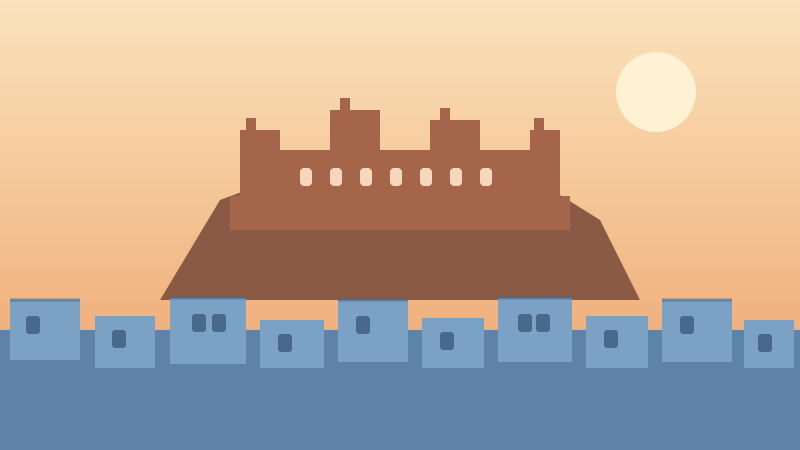
The Garh Palace climbs the hillside above the old town in stages, added to by successive Hada Chauhan rulers from the sixteenth century onward. Rudyard Kipling, who came in the 1880s, described it in Letters of Marque as “the work of goblins rather than of men” — which is a better description than anything I can offer, and holds up when you stand at the foot of the ramp looking at the elephant-carved Hathi Pol gate.
Inside, the palace is only lightly maintained: dust, pigeons, bats in the upper rooms, vegetation in the courtyards, and long stretches with nobody in them but you. Some visitors find that shabby. Most find it the point — this is what a Rajput palace looks like when it hasn’t been turned into a five-star hotel.
The reason to come is the Chitrashala. Tucked in a garden courtyard above the main palace is a colonnaded gallery whose walls and ceilings carry the finest surviving murals of the Bundi school of painting — eighteenth century, worked in a distinctive turquoise-and-green ground, dense with Krishna legends, raga scenes, hunts, processions, court life, and women at every occupation the court could imagine. Panel after panel, running unbroken around the arcade.
They have never been properly restored, and there is no lighting. Two practical consequences: go in the middle of the day, when indirect light reaches furthest under the arcade, and carry a torch — a phone will do — so you can read the deeper ceiling panels. Don’t touch the walls. Don’t use flash. What survives here survives on borrowed time, and the odds are better if visitors behave.
Allow two hours for palace and Chitrashala together, longer if you’re the sort who looks at paintings properly.
Taragarh Fort
Above the palace, the Star Fort of 1354 sprawls across the ridge in a state of magnificent collapse — tumbled ramparts, dry tanks cut into rock, gates opening onto scrub, and the great Bhim Burj bastion where the huge Garbh Gunjan cannon still sits pointing over the town.
The climb up from the palace is steep, rough and partly overgrown. It’s worth doing for the view alone: the blue town below, Nawal Sagar lake with the half-submerged Varuna temple in the middle of it, and the Aravalli hills folding away. Go early morning, wear proper shoes, take water.
The langurs are a genuine consideration rather than a charming detail. They are numerous, bold, and interested in bags and food. Carry a stick if the ticket-seller offers you one, don’t carry visible snacks, and don’t make eye contact. This is standard advice locally, not nervousness.
The stepwells
Bundi’s real distinction — the thing it has that nowhere else in Rajasthan does at this density — is its baoris. The town had more than fifty stepwells, built over centuries because the site had no reliable surface water, and many of them are architectural set pieces rather than utilities.
Raniji ki Baori is the one to see, and it belongs in the first rank of Indian stepwells: built in 1699 by Rani Nathavati, more than 40 metres deep, a high carved gateway, tiers of steps descending in narrowing symmetry, and carved brackets and elephant figures on the way down. It’s on a quiet lane, it takes twenty minutes, and there is a decent chance you’ll be alone in it.
Then there are the Nagar Sagar Kunds — twin stepwells sunk directly beside the main bazaar gate, so you emerge from a street of vegetable sellers to find the ground opening into two matched geometric pits. Dabhai Kund, on the edge of town, is the largest and the most overgrown.
Ask locally which are currently open and clean; maintenance varies year to year. Don’t climb down into water, and be careful on wet steps.
The blue old town
Bundi’s houses are washed in the same indigo as Jodhpur’s, in a tighter, lower, more domestic grid — no wide bazaars, no traffic to speak of, just lanes of blue doorways with the palace hanging over the rooftops. It’s the most pleasant town walk in Rajasthan, and the entire old town takes about an hour to cross at a stroll.
The manner is the same as in Jodhpur’s Blue City: these are homes, and the doorstep you’re framing belongs to someone. Ask before photographing people. Accept the tea if it’s offered; Bundi still offers.
Water, Kipling and the lakes
North of the old town, Jait Sagar lake runs along the base of the hills, fringed with lotus in the right season. On its bank stands Sukh Mahal, a small pleasure palace with a chhatri over the water, where local tradition holds Kipling stayed and worked on Kim. Treat that as affectionate lore rather than established fact — what’s certain is that he was in Bundi, that he wrote about it vividly, and that the setting is easy to believe.
Also worth the walk: the Chaurasi Khambon ki Chhatri, an eighty-four pillared cenotaph on the edge of town, and Nawal Sagar, the tank in the middle of the old town that reflects the entire palace when the water is high.
How long, and the honest case for two nights
One night is enough to see the palace, the Chitrashala and Raniji ki Baori, and most people who stop here give it exactly that.
Two nights is what Bundi is actually for. The whole appeal is a place small enough to stop moving in — a morning on the fort, an afternoon among stepwells, an evening on a rooftop with the floodlit palace above you and nothing scheduled. Bundi is also, by some distance, the cheapest good place to stay in Rajasthan, so the extra night costs almost nothing.
If you’ve been running Jaipur–Jodhpur–Udaipur at pace, put your rest day here rather than losing it to a travel day.
Where it fits
Bundi’s problem is purely geographic: it sits off the main tourist triangle, so it has to be deliberately inserted. Two clean ways in.
- Between Udaipur and Jaipur. Udaipur → Chittorgarh → Bundi is a good day: two hours to the fort, three or four hours there, then on to Bundi by evening. Next morning Bundi, and the following day the four-hour run to Jaipur. Our 10-day route has the room for exactly this.
- With Ranthambore. Ranthambore is about three and a half hours away, which makes tiger reserve plus painted palace a neat and unusual pairing that avoids the standard circuit almost entirely.
On a 7-day trip Bundi generally doesn’t fit, and forcing it means cutting somewhere better known. On any trip of ten days or more, it’s among the first things I’d add.
Where to stay
Family-run haveli guesthouses in the old town are the whole point — carved stone rooms, a rooftop with a palace view, and a home-cooked thali that beats anything on a menu. Several sit around Nawal Sagar and along the lanes below the palace, and prices are low enough that the good ones are still cheap. Book the rooftop room.
Avoid the highway hotels unless you’re arriving late; being able to walk everywhere is most of what makes Bundi work.
Getting there and when to come
The main railhead is Kota, 36 kilometres away and about an hour by road, with strong connections on the Delhi–Mumbai line including trains from Delhi, Sawai Madhopur and points south. Bundi has its own small station, but with a thin timetable — check what actually runs before relying on it.
By road: Jaipur about 4 hours, Chittorgarh about 3, Udaipur about 5, Sawai Madhopur about 3.5, Ajmer and Pushkar about 4.
Come October to March for the standard reasons. But Bundi is one of the few places in Rajasthan with a real case for the monsoon: the lakes fill, the hills around Taragarh turn green, the town celebrates Kajli Teej with processions in the weeks after Raksha Bandhan, and hardly anyone is around. It is humid and the fort climb gets slippery — a fair trade, if you like a place best when it’s wettest. See best time to visit Rajasthan for the full seasonal picture.